01 — Overview
The app worked, but it no longer served the full customer journey.
ValueClub members could earn cashback and e-credits by scanning their membership in store. Beyond that moment, the experience was fragmented and important after-sales tasks lived elsewhere.
The redesign needed to do more than modernise the interface. It had to centralise member value, enable self-service and make the product useful to both existing and potential members.
My role
As the sole designer, I led research, UX strategy, information architecture, wireframing, interface design, prototyping, usability testing and iteration.
02 — The challenge
Membership value was difficult to see—and support was doing work the app could do.
The outdated structure made common tasks hard to find. Customers could not check e-receipts or warranty status in the app, so routine enquiries went directly to the customer experience team.
Problem statement
How might we make ValueClub benefits easier to discover while helping customers resolve common after-sales needs independently?
Fragmented
Features were grouped around the existing system rather than user goals.
Dependent
Receipts and warranty checks required customer-service assistance.
Member-only
Potential members could not meaningfully explore the product.
03 — Research
Research narrowed a broad redesign into three specific barriers.
I interviewed customers and internal stakeholders, then tested the existing experience with staff and real users.
What the research revealed
- 1
Benefits were difficult to discover. Members could not readily see the rewards and services available to them.
- 2
After-sales information was inaccessible. Receipts and warranty details sat outside the app experience.
- 3
The interface reduced confidence. Weak hierarchy and an outdated structure made navigation uncertain.
04 — From insight to solution
Every major design decision answered a research finding.
The new information architecture centred the experience on four goals: discover value, manage purchases, get support and understand membership.
Research insight
Benefits and common features were difficult to find.
Design decision
Reorganise navigation around user goals—not legacy feature categories.
What changed
Rewards, purchases, warranties and promotions became clearer destinations.
Research insight
Receipts and warranty information were unavailable in the app.
Design decision
Bring purchase history and warranty status into the core experience.
What changed
Customers could resolve routine after-sales questions without contacting support.
Research insight
The product only demonstrated value after someone became a member.
Design decision
Create a useful guest experience while preserving member-only benefits.
What changed
Potential members could explore promotions and understand ValueClub before joining.
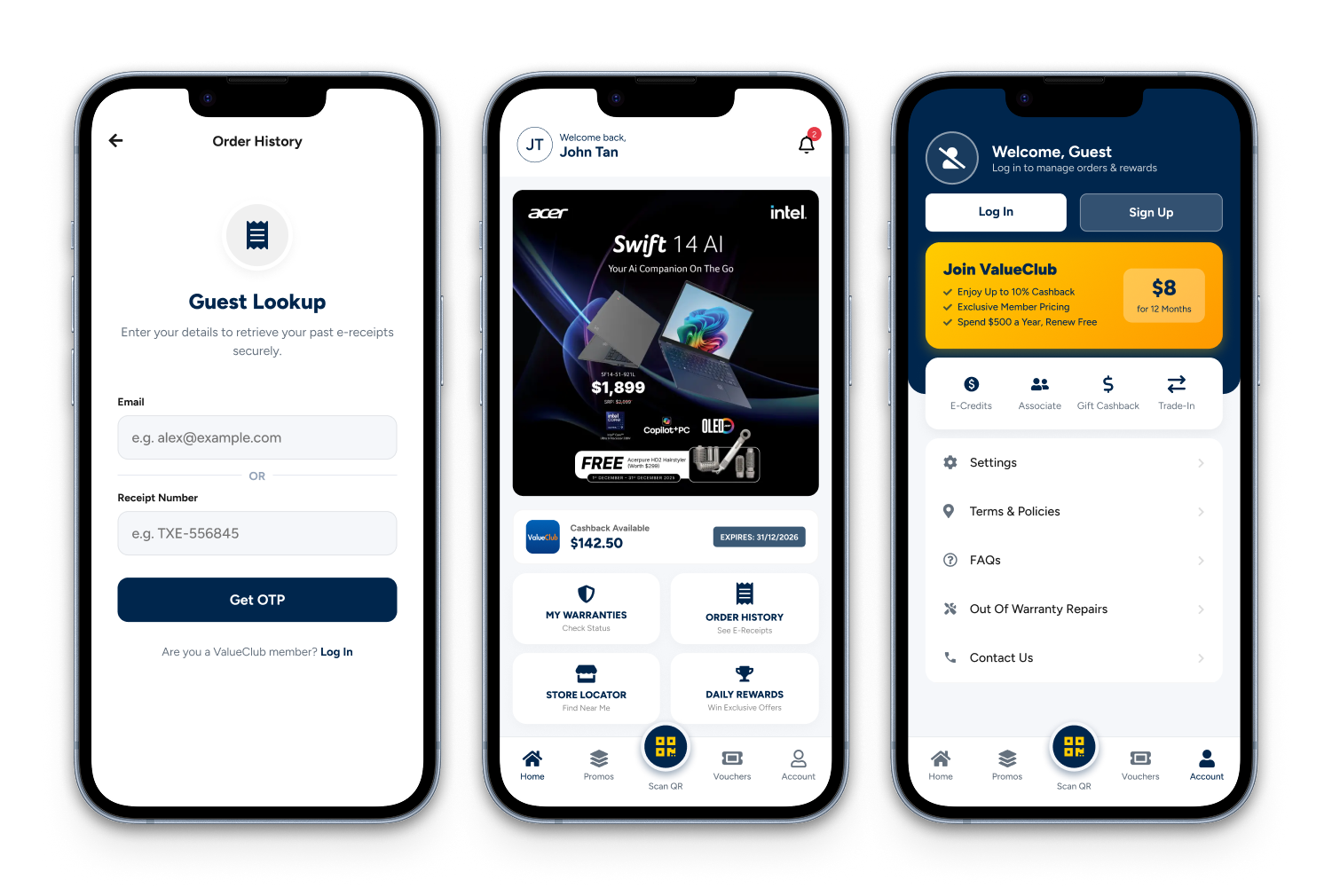
Key features introduced or improved
E-receipts
Purchase history became available on demand.
Warranty tracking
Protection status and support tools moved into the app.
Promotions & vouchers
Benefits were surfaced earlier and more clearly.
Guest experience
Non-members could explore value before signing up.
Store locator
Stores and service centres became easier to discover.
Membership tools
Account, cashback and associate-member tasks were consolidated.
05 — Validation
Testing focused on the tasks the original app made difficult.
Staff and real users tested the revised structure and key journeys. The redesign made it easier and faster to find receipts, check warranty status and discover promotions.
Find a previous receipt
Easier to locateCheck warranty status
Available in-appDiscover promotions
Surfaced earlier06 — Impact
The clearest result was a major reduction in support demand.
Making receipts and warranty information self-service reduced pressure on the customer experience team. The clearer structure also made rewards and promotions easier to discover, while the guest experience introduced ValueClub to potential members.
Self-service
Customers could handle more after-sales tasks without contacting support.
Engagement
Rewards and promotions were easier to discover in everyday use.
Growth
Non-members could understand the value proposition before joining.